
Welcome to the Sage 50 hub – discover how to move to Sage Intacct
A finance leader’s starting point for moving beyond Sage 50. This hub gives you clear guidance, practical tools, and expert advice to plan a confident move to Sage Intacct.
Proud of our:
Move from Sage 50 to Sage Intacct
Challenges growing businesses experience with Sage 50
As organisations add entities, projects and new reporting demands, Sage 50 becomes harder to stretch. Real-time visibility is limited, month-end slows under manual reporting, and workarounds for approvals, consolidations, and currencies raise risk. Disconnected tools create duplication, investor and board reporting needs more depth and speed, and forecasting rooted in spreadsheets struggles to keep up. Compliance questions take longer to answer, audit trails are incomplete, and remote teams spend too much time chasing versions instead of making decisions.
This hub is your starting point for moving beyond Sage 50 with Sage Intacct. The goal is simple: faster close, stronger control and one version of the truth that scales with your business. Below are some typical challenges of using Sage 50 as your business grows.
How Sage Intacct is a step up from Sage 50
Sage Intacct is a cloud native financial management solution that helps CFOs modernise operations, gain real-time visibility, and lead with confidence. Built for growing organisations, it replaces spreadsheet work with automation, delivers one version of the truth, and scales easily across entities and teams. Sage Intacct supports finance teams with:
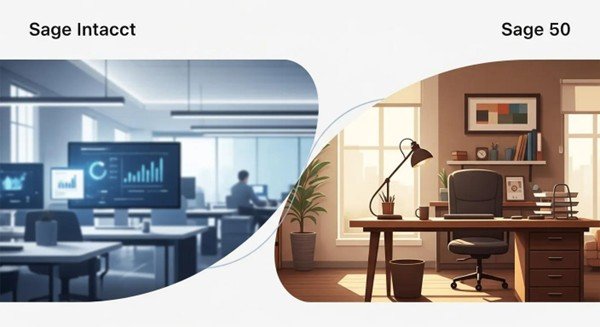
Sage 50 vs. Sage Intacct features
| Feature | Sage 50 | Sage Intacct |
|---|---|---|
| Real-Time Reporting | Limited real-time visibility | Comprehensive real-time dashboards |
| Multi-Entity Support | Manual consolidation required | Seamless multi-entity management |
| Cloud Accessibility | Desktop-based, limited remote access | Fully cloud-native, accessible anywhere |
| Automation | Manual processes dominate | Extensive automation capabilities |
| Compliance Tools | Basic controls | Built-in compliance and audit features |
Sage Intacct industries











Further reading on moving from Sage 50 to Sage Intacct




Explore Sage Intacct and industry Articles


FAQs for moving from Sage 50 to Sage Intacct
Industries that typically benefit include services-based businesses such as professional services and private equity-backed, transportation etc. These sectors face multi-entity, multi-currency and project-level complexity where Sage Intacct’s cloud architecture, automation and dimensional reporting provide clear operational and reporting advantages.
Automation streamlines repetitive tasks like invoice processing, reconciliations and reporting, cutting manual entry and error risk. That frees finance to focus on analysis and decision support. Automated workflows also strengthen control and compliance while enabling quicker responses to operational issues.
Measure success with KPIs such as time-to-close, headcount efficiency and reporting accuracy. Track reductions in manual processes and the speed of consolidated reporting and collect user feedback to evaluate adoption and identify optimisation opportunities.
Sage Intacct delivers multi-dimensional reporting, real-time dashboards and drill-down capabilities that go beyond Sage 50’s standard reports. These features let teams analyse by department, project or location and produce stakeholder-ready reports more quickly. Built-in automation also reduces manual reconciliations, improving accuracy and the timeliness of financial information.
When weighing an upgrade, review operational triggers such as repeated manual processes, rising transaction volumes and the need for near-real-time reporting. Factor in strategic goals, entering new markets or managing multiple entities, and assess integration complexity. A structured migration plan that includes data cleansing, user training and stakeholder engagement is essential to keep disruption to a minimum.
Sage 50 usually follows a desktop licence model with lower entry cost for small businesses. Sage Intacct generally uses subscription and modular pricing aligned to required modules and user counts for mid‑market organisations. Subscription costs can look higher initially but often yield lower total cost of ownership over time through automation, reduced manual work and removal of third‑party consolidation tools. Organisations should weigh pricing against expected efficiency gains and scalability needs.
- Migration readiness: Assess consolidation needs and reporting pain points before deciding
- ROI focus: Prioritise KPIs such as close time and manual reconciliation hours when evaluating vendors
- Partner selection: For complex migrations, choose an implementation partner experienced in multi‑entity deployments
Following these steps helps ensure the technical choice aligns with strategic growth objectives and operational realities.
Intacct supports native consolidation across legal entities with automated intercompany eliminations and dimension based reporting to simplify group accounting. Automated currency translation and configurable exchange rate handling streamline multi currency reporting. These built in capabilities help finance teams produce consolidated statements and investor packs faster and with greater confidence, improving auditability and cutting manual consolidation work.
Businesses typically outgrow Sage 50 when manual consolidations increase, spreadsheet dependency grows, month end slows or advanced needs like project accounting and revenue recognition appear. Intacct addresses these limits with native multi entity support, automation and real time analytics that reduce manual effort and strengthen controls. The practical result is faster access to reliable management information and lower reporting risk.
The core difference is architecture and scale: Sage Intacct is a cloud native, scalable financial management platform built for multi entity, high volume operations; Sage 50 is a desktop accounting package aimed at single entity small businesses. That architectural gap affects reporting, automation, integration and suitability for growth. Organisations needing consolidated reporting, automation and strong integrations will generally favour Intacct for long term fit.
Cloud-native means the solution is purpose-built for the cloud, not simply hosted there. It gives you secure, browser-based access to your data anytime, anywhere, from any internet-connected device. By eliminating the need to manage on-premises infrastructure, it also frees up time and resources to focus on strategic priorities.
You should see immediate improvements in automation, faster month-end close, simplified consolidations, custom reporting, and better real-time visibility across your finances, all within a secure, cloud-native environment.
With a trusted partner like Inixion, the transition is seamless. We follow a structured migration process that includes data cleansing, system configuration, training, and go-live support, ensuring minimal disruption to your operations.
Sage 50 is ideal for smaller businesses, but it often lacks the scalability, automation, and multi-entity capabilities that growing companies need. Sage Intacct is a modern cloud-native solution that offers real-time reporting, automation, and the flexibility to support your evolving financial needs.
Implementation timelines vary based on business complexity, but small to mid-sized businesses typically go live within 2-4 months. Our experienced consultants ensure a fast, efficient deployment tailored to your needs.


