
Sage 50 or Sage Intacct: the short answer
Sage 50 remains a strong choice for smaller businesses with relatively straightforward accounting requirements. It provides familiar desktop accounting, invoicing, cash flow management, stock control and UK tax compliance at a lower cost than Sage Intacct.
Sage Intacct is designed for growing and mid-sized organisations with more complex finance requirements. It becomes the stronger option when you need cloud-native access, sophisticated multi-entity consolidation, dimensional reporting, advanced automation or better integration with other business systems.
Moving to Sage Intacct is not simply a software upgrade. It is a move to a different financial management solution, designed to support greater organisational scale and complexity.

What is the main difference between Sage 50 and Sage Intacct?
Sage 50 and Sage Intacct are both Sage products, but they are designed for different stages and levels of financial complexity.
Sage 50 is desktop accounting software with cloud-connected features. It is designed primarily for small businesses that need dependable accounting, invoicing, cash flow management, stock control and UK compliance.
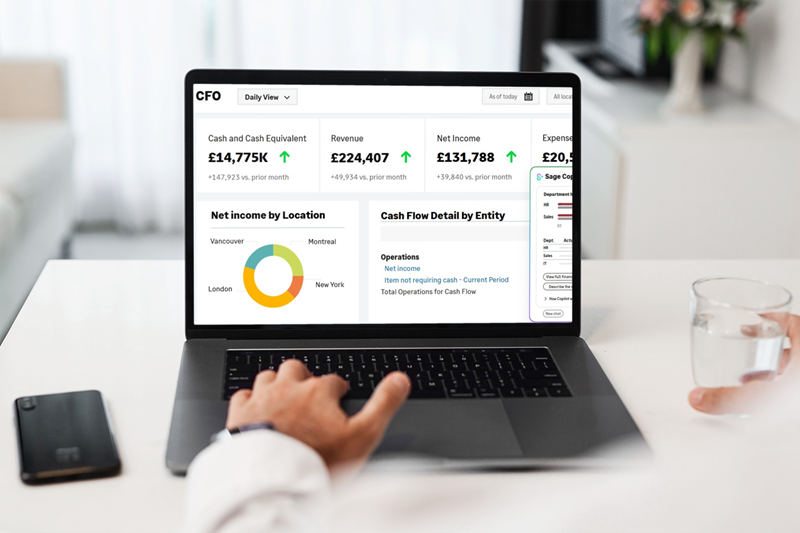
Sage Intacct is a cloud-native financial management solution for growing and mid-sized organisations. Its strengths include multi-entity accounting, consolidation, dimensional reporting, advanced automation and integration with other business systems.
Sage Intacct vs. Sage 50
| Area | Sage 50 Accounts | Sage Intacct |
|---|---|---|
| Best suited to | Small businesses with straightforward or moderately complex accounting needs | Growing and mid-sized organisations with more complex financial management requirements |
| Users | Subscription includes a set number of users, with additional users available at extra cost | User and role-based subscription that can scale with the organisation |
| Companies & entities | Can manage multiple companies, departments and budgets, with more advanced capabilities in Professional | Designed for centralised multi-entity management, consolidation and intercompany accounting |
| Deployment | Desktop software with cloud connectivity and remote-access options | True cloud-native financial management solution accessed through a web browser |
| Automation | Includes bank reconciliation, recurring transactions, document capture and other automation | More advanced workflows across approvals, allocations, consolidations, billing and month-end processes |
| Consolidation | Multi-company reporting is available, but complex group consolidation may require more manual work | Multi-company reporting is available, but complex group consolidation may require more manual work |
| Multi-currency | Available, with differences depending on the Sage 50 plan selected | Available, with differences depending on the Sage 50 plan selected |
| Project accounting | Project costing is available in Sage 50 Professional | Project tracking, time and expenses, project costing and advanced billing options are available |
| Integrations | Connects with a range of Sage and third-party applications | Broader integration capabilities through APIs, platform services and marketplace applications |
| MTD | HMRC-recognised and MTD-ready | Supports UK tax and compliance requirements, including MTD |
| Indicative UK software cost | Standard currently starts from £115 plus VAT per month and Professional from £234 plus VAT per month | Core platform with five users currently starts from approximately £1,137 plus VAT per month, with final pricing based on users, entities and modules |
| Implementation | Generally quicker and less complex to introduce | Requires a scoped implementation covering design, configuration, data migration, testing and training |
Please note: Prices are indicative and correct at the time of publication. Software offers and pricing can change. Sage Intacct implementation, support and professional services are priced separately according to project scope.
Signs your business may have outgrown Sage 50
Outgrowing Sage 50 is not necessarily about turnover or employee numbers. The clearest signs usually appear in the workload and complexity facing your finance team.
You may be ready to consider Sage Intacct if:
- Group consolidation depends heavily on spreadsheets
- Month-end is taking longer as the business grows
- Your team repeatedly exports data to build management reports
- Multiple entities, currencies or locations are becoming difficult to manage
- Approval processes rely on emails and manual follow-up
- Finance data is spread across disconnected systems
- Senior leaders cannot access timely, dependable financial information
- New users, transactions or reporting demands are affecting performance
- Project, department or location reporting requires chart-of-accounts workarounds
- Your finance team is spending more time assembling information than analysing it
One of these issues alone may not justify changing systems. If several are affecting productivity, control and decision-making, it is worth assessing whether Sage 50 still provides the right foundation.
Can you move from Sage 50 to Sage Intacct?
Yes. Moving from Sage 50 to Sage Intacct involves implementing a new financial management solution and transferring agreed data from your existing system. It is not an automatic software upgrade, but a structured implementation project.
A typical project includes:
- Discovery and requirements gathering
- Solution design and configuration
- Data review and cleansing
- Migration of agreed records and balances
- Integrations and reporting setup
- User testing
- Training
- Go-live and post-launch support
The scope of the data migration should be agreed early. Some organisations transfer detailed historical transactions, while others bring across opening balances, master records and selected comparative data.
How long does it take to move from Sage 50 to Sage Intacct?
Sage 50 has a substantially lower starting price and is likely to remain the more cost-effective choice for businesses with straightforward accounting needs.
Sage Intacct requires a greater investment because it supports more complex financial management. Pricing depends on the edition, users, entities and modules selected. A quotation will normally include software subscriptions, implementation services and ongoing support.
The comparison should therefore consider more than licence price. Finance teams should also assess the time spent on manual consolidation, spreadsheet reporting, reconciliations, system maintenance and correcting avoidable errors.
For current indicative pricing, visit our Sage Intacct pricing guide.
How do Sage 50 and Sage Intacct costs compare?
The timeframe depends on the number of entities, data quality, required integrations, reporting complexity and the availability of your internal project team.
Inixion will assess these requirements before providing a project plan with clear stages, responsibilities and timescales. Data preparation, testing and internal decision-making can have as much influence on the timeframe as the technical configuration.
Sage Intacct is a futureproof solution that’s accessible anytime, anywhere*
*Ref: Sage


Why partner with Inixion?
Choosing the software is only part of the change. The design of entities, dimensions, approval workflows, integrations and reports will determine whether the new finance solution works in practice.
Inixion combines Sage experience with a structured implementation approach. Our UK-based team helps you define requirements, configure Sage Intacct, migrate data, train users and support the solution after go-live.
- 100% success rate across Sage implementations since 2006
- 84% customer Net Promoter Score
- UK-based consultants and support
- 20 years in the Sage ecosystem
FAQs – Sage Intacct vs. Sage 50


