Sage Intacct vs Sage 50 – a practical guide for finance leaders
Sage 50 and Sage Intacct serve very different needs. Sage 50 is a desktop accounting package that suits single-entity, small-business bookkeeping. Sage Intacct is cloud-native and built for growing mid-market organisations that require multi-entity consolidation, automation and near‑real-time financial insight. This article walks finance leaders through those practical differences, deployment, reporting, automation and migration, and shows the clear signals that indicate when a move from Sage 50 to Intacct is the right next step. We focus on outcomes you care about: faster month-ends, stronger controls and clearer financial visibility so you can judge each product against your growth plans and operational constraints.
Core features and limits of Sage 50 for small businesses
Sage 50 is a conventional desktop accounting tool for single-company bookkeeping and daily accounting tasks. It delivers the essentials, general ledger, accounts payable, accounts receivable and basic inventory, using a file-based architecture suitable for a single-office setup. Common activities like invoicing, bank reconciliation and payroll integration are straightforward, and reports follow a worksheet-style layout finance teams recognise. That simplicity brings trade-offs: remote access and multi-user collaboration depend on VPNs or hosted desktops, and IT overhead rises as teams scale. Knowing these limits helps small businesses decide whether Sage 50 still fits or if a cloud ERP will better support future growth.
Which accounting functions does Sage 50 cover for basic financial management?
Sage 50 provides the core modules needed for compliant month-end and statutory records: a GL for postings and close, AP and AR workflows, and invoicing for billing. Reporting is typically static financial statements and simple custom extracts, fine for single-entity, single-currency operations without complex consolidations. Inventory supports basic stock control but isn’t built for multi-site tracking, lot traceability or advanced costing. In short, Sage 50 delivers reliable bookkeeping for smaller organisations but limits deeper analytics and consolidated reporting as complexity increases.
Key limitations of Sage 50 as your business grows

Limitations surface as transaction volumes, entity count, or reporting needs increase. Month-end can slow down because of manual reconciliations and spreadsheet workarounds; intercompany eliminations are often manual or unsupported. Integration choices are narrower than with cloud platforms, so connecting CRM, payroll or operational apps may require third‑party tools or exports. Because data is file-based, remote teams face access and security hurdles. These operational pain points commonly prompt finance teams to evaluate cloud-native alternatives that automate intercompany processes and provide auditable, real‑time reporting.
- Core bookkeeping: GL, AP, AR and simple inventory
- Manual consolidation and spreadsheet dependence can lengthen month‑end
- Limited APIs and remote access increase IT and process overhead
Those signs point to considering a cloud-native platform with built-in consolidation and broader automation.
How Sage Intacct’s cloud-native platform helps growing and mid-market businesses

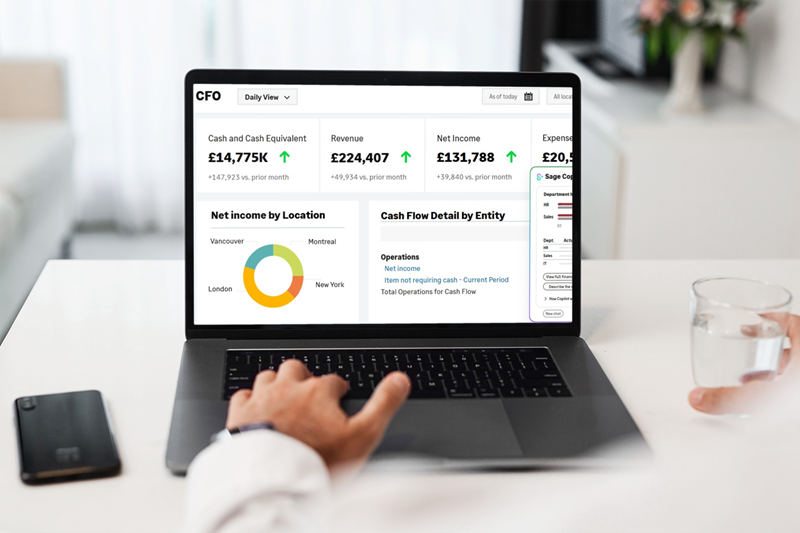
Sage Intacct is a cloud-first financial management platform that scales for multi-entity accounting, delivers multi-dimensional reporting in real time and uses workflow automation to accelerate the close and improve visibility. Its separated application and data layers enable automatic updates, secure remote access and elastic performance as volumes rise, reducing internal IT burden and supporting distributed teams. For mid-market organisations that need consolidated statements, Intacct’s native multi-entity and dimension-based reporting lets finance teams produce audited consolidations quickly. The platform’s automation and open integrations reduce manual reconciliations and free finance to focus on analysis and strategic reporting.
Advanced financial features and automation in Sage Intacct
Intacct offers multi-dimensional GL reporting, automated intercompany eliminations, project accounting, revenue recognition and configurable approval workflows that remove routine manual tasks. It can auto‑post recurring entries, simplify AP/AR approvals and produce consolidated financials across entities with consistent accounting rules. A rich API ecosystem and marketplace of integrations connect CRM, payroll and operational systems so data feeds into Intacct for near real‑time analytics. Practically, that means faster closes, fewer spreadsheet-driven adjustments and timelier management information.
Why cloud deployment matters for financial management
Cloud deployment matters because it enables continuous updates, centralised security and universal access for finance and stakeholders, supporting remote and hybrid working models. Automatic updates deliver regulatory and functional improvements without disruptive upgrade projects, and hosted infrastructure scales to handle month‑end peaks. The cloud also simplifies integrations with stable APIs and removes much of the internal server, backup and patch burden. These operational advantages improve finance productivity, strengthen controls and make it easier to support growth without repeated platform replacements.
When organisations are ready to evaluate implementation, Inixion provides specialist Sage Intacct implementation and cloud migration services: configuration, training and post‑go‑live support tailored to mid-market needs. Inixion’s Sage X3 and Sage Intacct expertise serves medium‑to‑large organisations across manufacturing, distribution, professional services and private equity-backed businesses in the UK and North America.
If you want help booking a Sage Intacct demo or discussing migration timelines and resourcing, a short exploratory call will clarify expected outcomes. Get in touch here.
Key differences between Sage Intacct and Sage 50 in financial management
The single biggest distinction is scale and architecture: Sage 50 is a desktop solution for small, single‑entity businesses; Sage Intacct is a cloud‑native financial management platform for multi‑entity, higher‑volume operations that need advanced reporting and automation. That architectural gap drives differences in deployment, update cadence, security models and integration capability. Intacct’s modular, API-centred ecosystem supports deeper integrations and industry customisation; Sage 50 remains a simpler, lower‑cost entry point with trade‑offs in scalability and analytics. For organisations requiring consolidated financials, automated intercompany accounting and live dashboards, Intacct is the stronger long‑term fit.
How deployment models differ: desktop Sage 50 vs cloud Sage Intacct
Deployment and maintenance contrast sharply. Sage 50 installs locally or runs on hosted desktops and uses file‑based data; Sage Intacct is delivered as SaaS with centrally managed infrastructure and continuous updates. The cloud model reduces internal IT maintenance and allows steady delivery of new features and security patches. Web access, single‑source data and role‑based security are native to SaaS, supporting distributed finance teams more effectively than desktop setups. These differences affect business continuity, scalability and total cost of ownership.
| Deployment Aspect | Sage 50 (Desktop) | Sage Intacct (Cloud) |
|---|---|---|
| Installation | Local install or hosted desktop | SaaS, centrally hosted |
| Updates | Manual or periodic upgrades | Continuous automatic updates |
| Remote access | Requires VPN or hosted sessions | Web access from any location |
| IT maintenance | Higher internal server and backup needs | Lower internal IT overhead |
Scalability and multi‑entity support: Intacct vs Sage 50
Sage Intacct natively supports multi‑entity consolidations, intercompany eliminations and granular dimension reporting, making it a strong fit for organisations with multiple legal entities or complex ownership structures. Sage 50 lacks robust multi‑entity features and typically depends on manual consolidation or third‑party tools, which lengthens month‑end and raises error risk. Intacct scales with transaction volumes and added entities, reducing the need for new systems as the business grows. For companies planning geographic expansion, acquisitions or complex holding structures, Intacct provides the architecture to keep accounting policies consistent and consolidated reporting timely.
Differences in reporting, analytics and automation
Reporting in Intacct is real‑time and multi‑dimensional, so teams can slice results by entity, department, project or custom dimension and use dashboards with drill‑downs for investigation. Sage 50 produces static reports and simple extracts that are often exported to spreadsheets for deeper analysis, which slows decision‑making. Automation in Intacct covers approvals, recurring entries, revenue recognition and project accounting; Sage 50’s automation is more limited and frequently needs manual intervention. Those gaps make Intacct better for proactive financial management and KPI‑driven performance monitoring across the organisation.
Integration ecosystem and user experience differences
Sage Intacct’s open API and partner marketplace make integrations with CRM, payroll and operational systems straightforward, enabling automated data flows and consistent master data. Sage 50 offers fewer native connectors and may require bespoke integration work or scheduled file transfers. On the UX side, Intacct provides a modern web interface and role‑based dashboards; Sage 50 retains a traditional desktop UI familiar to small‑business users but less flexible for diverse stakeholder roles. The Intacct ecosystem and interface reduce manual handoffs and support broader enterprise workflows.
Pricing models and industry features compared
Pricing models differ materially. Sage 50 generally uses a desktop licence with lower initial cost, suitable for smaller businesses. Sage Intacct typically uses subscription and modular pricing aligned to the modules and user counts you choose. Intacct’s modular approach lets companies add project accounting, multi‑entity or revenue recognition features as needed, tying cost to functional value for mid‑market firms. While Sage 50’s licence can be cheaper initially, bridging functionality gaps with manual work or third‑party tools can raise total cost over time. Evaluate pricing alongside expected efficiency gains and future growth.
| Product | Deployment | Scalability | Reporting | Typical Pricing Model |
|---|---|---|---|---|
| Sage 50 | Desktop | Small‑business scale | Static reports | Desktop licence |
| Sage Intacct | Cloud native | Mid market, multi entity | Real time, multidimensional | Subscription, modular |
When to consider migrating from Sage 50 to Sage Intacct
Consider migration when operational complexity, multiple entities, rising transaction volumes, slow month‑end or heavy spreadsheet use, starts to impede decision‑making and growth. Common migration triggers include the need for native multi‑entity consolidation, burdensome manual reconciliations, poor integration with key systems, or the requirement for automated revenue recognition and project accounting. A migration decision weighs current pain points against the expected ROI from faster closes, less manual work and clearer financial visibility. The table below is a quick decision matrix to help leadership assess readiness and next steps.
| Signal | Impact | Recommended action |
|---|---|---|
| Multi‑entity growth | Consolidation delays | Evaluate Intacct and plan migration |
| Spreadsheet‑heavy reporting | Increased error risk | Introduce automation and integrated reporting |
| Slow month‑end | Delayed insights | Prioritise automation and close workflow redesign |
Signs your business has outgrown Sage 50
Practical signs you’ve outgrown Sage 50 include repeated manual consolidations, frequent spreadsheet reconciliations for reporting, inability to support concurrent remote users, and the need for advanced modules like project accounting or revenue recognition. These recurring issues create bottlenecks that undermine auditability, control and decision speed. When finance leaders see these symptoms consistently, a migration to a cloud‑native financial platform typically delivers measurable improvements. The next section outlines the typical benefits and ROI to expect.
Benefits and ROI of migrating to Sage Intacct
Migrating to Intacct commonly shortens the month‑end close, reduces time spent on manual reconciliations, strengthens audit trails and delivers real‑time visibility across entities and dimensions. Typical ROI levers include lower transactional headcount hours, fewer correcting entries and faster access to consolidated financials for investor or board reporting, particularly important for private equity‑backed businesses. Post‑migration KPIs to monitor include close cycle time, manual journal edits, report generation time and reporting accuracy. These measurable gains often justify migration costs through operational savings and improved financial control.
If you’re preparing to migrate, Inixion provides migration and post‑go‑live services tailored to Sage Intacct transitions, including configuration, data migration and user training. With a specialist focus on Sage Intacct and Sage X3 for medium to large organisations, Inixion’s case‑study approach helps set realistic timelines and expected outcomes during scoping.
How Inixion supports successful Sage Intacct implementation and migration
Inixion Limited delivers end‑to‑end Sage Intacct services: assessment, project management, system configuration, data migration and post‑go‑live support and training, all designed to minimise disruption and deliver measurable outcomes. We align Intacct configuration with each client’s accounting policies, reporting needs and integrations so the solution supports consolidation, automation and KPI reporting from day one. Operating across the UK, Inixion brings Sage Intacct expertise that de-risks migration and accelerates time‑to‑value for manufacturing, distribution, professional services and private equity portfolios.
Implementation and support services Inixion offers for Sage Intacct
Inixion structures projects around proven phases: pre‑implementation discovery and process mapping, implementation project management and configuration, data migration and validation, and post‑go‑live support and training to embed new processes and upskill finance teams. Our consultancy work includes industry‑specific reporting templates, configuring multi‑entity consolidations and defining integration patterns with operational systems for consistent master data and automated flows. Ongoing support covers troubleshooting, upgrades and advisory services to extend Intacct as your needs evolve, all aimed at realising the efficiency and control benefits of a cloud financial system.
Industry advantages of Sage Intacct versus Sage 50
Sage Intacct addresses industry challenges that Sage 50 cannot scale to manage effectively, notably multi‑site operations, project accounting and investor reporting. In manufacturing and distribution, Intacct improves inventory accuracy and multi‑site consolidation through integrations and real‑time reporting. For professional services, it enables project‑based revenue recognition and profitability analysis. Private equity‑backed firms gain rapid consolidated investor packs, audit‑ready trails and governance‑ready reporting. Mapping capability to sector pain points highlights where a cloud‑native approach outperforms desktop accounting.
Why Sage Intacct suits professional services and private equity‑backed firms
For professional services, Intacct’s project accounting and time‑and‑billing integrations provide accurate revenue recognition and project‑level profitability analysis, helping firms track margins and resource utilisation precisely. Private equity‑backed firms benefit from Intacct’s native consolidation, audit‑ready trails and fast investor‑pack generation across portfolio companies, supporting governance and faster decision cycles. Configurable dashboards and dimensional reporting also make it easier to align operational KPIs with investor expectations and deliver consistent financial views across a group.
Conclusion
Choosing between Sage Intacct and Sage 50 comes down to scale and future needs. Sage Intacct delivers advanced automation, real‑time reporting and native multi‑entity support, a strong match for growing organisations with complex requirements. Sage 50 remains a sensible, lower‑cost option for straightforward, single‑entity bookkeeping. Understand your pain points, quantify likely ROI and, if needed, speak with a specialist to scope migration timelines and outcomes. If you’d like tailored guidance or a demo of Sage Intacct, our team is ready to help.
Common questions about Sage Intacct vs Sage 50
Decision‑makers frequently ask which product fits their stage, why teams outgrow desktop accounting, how Intacct handles multi‑entity and multi‑currency accounting, and what pricing differences to expect between subscription and licence models. Clear, practical answers help executives weigh options when evaluating Sage Intacct versus Sage 50. The Q&A below addresses these points concisely.
FAQs
Industries that typically benefit include services-based businesses such as professional services and private equity-backed, transportation etc. These sectors face multi-entity, multi-currency and project-level complexity where Sage Intacct’s cloud architecture, automation and dimensional reporting provide clear operational and reporting advantages.
Automation streamlines repetitive tasks like invoice processing, reconciliations and reporting, cutting manual entry and error risk. That frees finance to focus on analysis and decision support. Automated workflows also strengthen control and compliance while enabling quicker responses to operational issues.
Measure success with KPIs such as time-to-close, headcount efficiency and reporting accuracy. Track reductions in manual processes and the speed of consolidated reporting and collect user feedback to evaluate adoption and identify optimisation opportunities.
Sage Intacct delivers multi-dimensional reporting, real-time dashboards and drill-down capabilities that go beyond Sage 50’s standard reports. These features let teams analyse by department, project or location and produce stakeholder-ready reports more quickly. Built-in automation also reduces manual reconciliations, improving accuracy and the timeliness of financial information.
When weighing an upgrade, review operational triggers such as repeated manual processes, rising transaction volumes and the need for near-real-time reporting. Factor in strategic goals, entering new markets or managing multiple entities, and assess integration complexity. A structured migration plan that includes data cleansing, user training and stakeholder engagement is essential to keep disruption to a minimum.
Sage 50 usually follows a desktop licence model with lower entry cost for small businesses. Sage Intacct generally uses subscription and modular pricing aligned to required modules and user counts for mid‑market organisations. Subscription costs can look higher initially but often yield lower total cost of ownership over time through automation, reduced manual work and removal of third‑party consolidation tools. Organisations should weigh pricing against expected efficiency gains and scalability needs.
- Migration readiness: Assess consolidation needs and reporting pain points before deciding
- ROI focus: Prioritise KPIs such as close time and manual reconciliation hours when evaluating vendors
- Partner selection: For complex migrations, choose an implementation partner experienced in multi‑entity deployments
Following these steps helps ensure the technical choice aligns with strategic growth objectives and operational realities.
Intacct supports native consolidation across legal entities with automated intercompany eliminations and dimension based reporting to simplify group accounting. Automated currency translation and configurable exchange rate handling streamline multi currency reporting. These built in capabilities help finance teams produce consolidated statements and investor packs faster and with greater confidence, improving auditability and cutting manual consolidation work.
Businesses typically outgrow Sage 50 when manual consolidations increase, spreadsheet dependency grows, month end slows or advanced needs like project accounting and revenue recognition appear. Intacct addresses these limits with native multi entity support, automation and real time analytics that reduce manual effort and strengthen controls. The practical result is faster access to reliable management information and lower reporting risk.
The core difference is architecture and scale: Sage Intacct is a cloud native, scalable financial management platform built for multi entity, high volume operations; Sage 50 is a desktop accounting package aimed at single entity small businesses. That architectural gap affects reporting, automation, integration and suitability for growth. Organisations needing consolidated reporting, automation and strong integrations will generally favour Intacct for long term fit.
Cloud-native means the solution is purpose-built for the cloud, not simply hosted there. It gives you secure, browser-based access to your data anytime, anywhere, from any internet-connected device. By eliminating the need to manage on-premises infrastructure, it also frees up time and resources to focus on strategic priorities.
You should see immediate improvements in automation, faster month-end close, simplified consolidations, custom reporting, and better real-time visibility across your finances, all within a secure, cloud-native environment.
With a trusted partner like Inixion, the transition is seamless. We follow a structured migration process that includes data cleansing, system configuration, training, and go-live support, ensuring minimal disruption to your operations.
Sage 50 is ideal for smaller businesses, but it often lacks the scalability, automation, and multi-entity capabilities that growing companies need. Sage Intacct is a modern cloud-native solution that offers real-time reporting, automation, and the flexibility to support your evolving financial needs.
Implementation timelines vary based on business complexity, but small to mid-sized businesses typically go live within 2-4 months. Our experienced consultants ensure a fast, efficient deployment tailored to your needs.