Welcome to the Sage 50 hub – discover how to move to Sage Intacct
A finance leader’s starting point for moving beyond Sage 50. This hub gives you clear guidance, practical tools, and expert advice to plan a confident move to Sage Intacct.
Proud of our:
Move from Sage 50 to Sage Intacct
Challenges growing businesses experience with Sage 50
As organisations add entities, projects and new reporting demands, Sage 50 becomes harder to stretch. Real-time visibility is limited, month-end slows under manual reporting, and workarounds for approvals, consolidations, and currencies raise risk. Disconnected tools create duplication, investor and board reporting needs more depth and speed, and forecasting rooted in spreadsheets struggles to keep up. Compliance questions take longer to answer, audit trails are incomplete, and remote teams spend too much time chasing versions instead of making decisions.
This hub is your starting point for moving beyond Sage 50 with Sage Intacct. The goal is simple: faster close, stronger control and one version of the truth that scales with your business. Below are some typical challenges of using Sage 50 as your business grows.
How Sage Intacct is a step up from Sage 50
Sage Intacct is a cloud native financial management solution that helps CFOs modernise operations, gain real-time visibility, and lead with confidence. Built for growing organisations, it replaces spreadsheet work with automation, delivers one version of the truth, and scales easily across entities and teams. Sage Intacct supports finance teams with:
Sage 50 vs. Sage Intacct features
| Feature | Sage 50 | Sage Intacct |
|---|---|---|
| Real-Time Reporting | Limited real-time visibility | Comprehensive real-time dashboards |
| Multi-Entity Support | Manual consolidation required | Seamless multi-entity management |
| Cloud Accessibility | Desktop-based, limited remote access | Fully cloud-native, accessible anywhere |
| Automation | Manual processes dominate | Extensive automation capabilities |
| Compliance Tools | Basic controls | Built-in compliance and audit features |
Sage Intacct industries










Further reading on moving from Sage 50 to Sage Intacct





Explore Sage Intacct and industry Articles

FAQs for moving from Sage 50 to Sage Intacct
Sage Intacct can support UK finance teams with VAT and Making Tax Digital requirements. The precise setup will depend on your organisation, entities and tax requirements and should be confirmed during the implementation process.
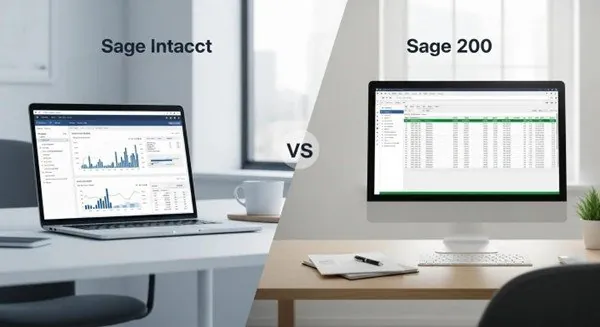
Neither solution is universally better. Sage 50 may be the better choice for a smaller business with relatively straightforward accounting needs. Sage Intacct is likely to be more suitable where growth has introduced multi-entity structures, complex reporting, manual consolidation or a need for more advanced automation.
Sage 50 has a lower starting subscription price. Sage Intacct requires a greater investment because it offers more advanced functionality and is configured around the users, entities and modules required. Implementation and ongoing support should also be included when comparing costs.
Yes, agreed data can be migrated from Sage 50 to Sage Intacct. The amount of historical detail transferred will depend on your requirements, data quality and project scope. Your implementation partner will help determine what should be migrated, archived or retained for reference.
You can move from Sage 50 to Sage Intacct, but it is not an automatic software upgrade. Sage Intacct must be designed and configured around your requirements, with an agreed approach to data migration, integrations, testing and training.
No. They are separate Sage products designed for different types of organisation. Sage 50 is desktop accounting software with cloud-connected features, primarily suited to smaller businesses. Sage Intacct is a cloud-native financial management solution designed for growing and mid-sized organisations with more complex reporting, automation and multi-entity requirements.