Key Takeaways
- Growing ingredient manufacturers often rely on dozens of interconnected spreadsheets across production, inventory and costing.
- Formulation changes become increasingly difficult to manage without version control.
- Limited visibility can slow production planning and decision-making.
- Manual reporting consumes valuable time and increases the risk of inconsistent information.
- Modern ERP connects formulation, inventory, production and finance within a single platform.
- Replacing operational spreadsheets doesn’t mean eliminating Excel – it means giving teams a reliable source of business data.
Executive Summary
Spreadsheets are invaluable tools, but ingredient manufacturers face a level of operational complexity that they were never designed to manage. As formulations, inventory, production planning and costing become more interconnected, maintaining accurate information across multiple spreadsheets becomes increasingly difficult. This article explores the operational signs that indicate your business has outgrown spreadsheets and how integrated ERP software provides greater visibility and control.
Why ingredient manufacturers reach their spreadsheet limit earlier
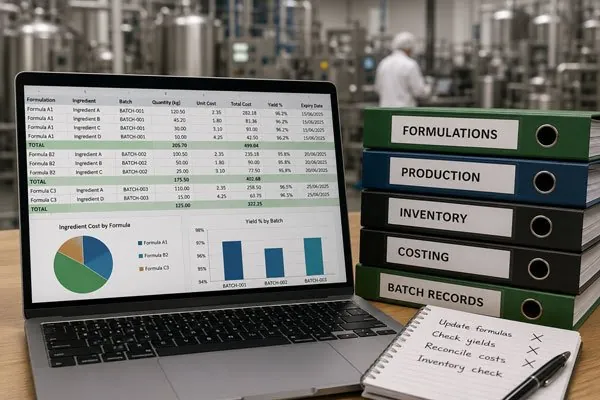
Many ingredient manufacturers still rely on spreadsheets to manage formulations, production schedules, batch records, inventory and raw material costs.
For many businesses, they’ve evolved over years and continue to play an important role in day-to-day operations. But as the business grows, spreadsheets often struggle to keep every process connected. Information becomes duplicated, manual updates increase, and it becomes harder to maintain a single, accurate view of what’s happening across the business.
Why ingredient manufacturing is different
Compared with many manufacturing sectors, ingredient manufacturers typically manage significantly greater operational complexity.
| Typical challenge | Operational impact |
| Hundreds of formulations | Difficult version control |
| Frequent ingredient substitutions | Manual updates across departments |
| Batch production | Greater planning complexity |
| Shelf-life management | Inventory decisions become time-critical |
| Variable raw material costs | Constant recipe cost changes |
| Lot-controlled inventory | Increased traceability requirements |
Each of these processes generates data.
When that data lives in separate spreadsheets, maintaining consistency becomes increasingly difficult.
Seven signs you’ve outgrown spreadsheets
1. Nobody knows which version is correct
One spreadsheet becomes five, the five become twenty!
Eventually, different departments are working with different information. If production, purchasing and finance are maintaining separate copies of the same data, confidence in reporting begins to decline.
2. Formulation changes create unnecessary work
Changing a formulation rarely affects only one document.
It often requires updates to:
| Area | Typical update required |
| Purchasing | Ingredient requirements |
| Production | Manufacturing instructions |
| Inventory | Stock planning |
| Costing | Product margins |
| Sales | Product specifications |
When every update is manual, delays and inconsistencies become inevitable.
3. Production planning takes longer than it should
Production planners need visibility of:
- Current inventory
- Customer demand
- Work orders
- Material availability
- Production capacity
If this information is spread across multiple spreadsheets, valuable planning time is spent gathering information instead of making decisions.
4. Reporting becomes a monthly project
Many finance and operations teams spend days combining spreadsheets before they can answer relatively simple questions.
Examples include:
- Which products generate the highest margin?
- Which ingredients have increased in cost?
- Which production lines deliver the best yield?
- Where are inventory losses occurring?
The larger the business becomes, the more difficult these reports become to produce.
5. Business growth creates more spreadsheets – not better visibility
Adding another spreadsheet often solves today’s problem.
Until next month.
Growing businesses frequently introduce:
- New products
- New suppliers
- Additional manufacturing sites
- More warehouses
- More employees
Each adds another layer of complexity.
6. Decision-making slows down
Management meetings increasingly begin with questions such as:
“Which report is correct?”
Instead of discussing improvement opportunities, teams spend time validating data.
That is usually a sign that operational information has become fragmented.
7. Operational visibility becomes the biggest challenge
The biggest limitation isn’t Excel.
It’s that spreadsheets cannot provide a live operational view across the business.
Leaders increasingly want answers to questions such as:
| Question | Why it matters |
| What inventory is available now? | Improve production planning |
| Which batches are currently in production? | Increase visibility |
| Which products are most profitable? | Better commercial decisions |
| Which ingredients are driving costs? | Margin protection |
| Where are production delays occurring? | Improve efficiency |
When this information exists within a single ERP platform, answers become available in real time rather than through manual reporting.
Spreadsheet vs ERP for Ingredient Manufacturers
| Capability | Spreadsheets | Modern ERP |
| Formulation management | Manual | Centralised |
| Production planning | Separate files | Integrated |
| Inventory visibility | Manual updates | Real-time |
| Batch management | Limited | Native functionality |
| Cost analysis | Manual calculations | Automated |
| Reporting | Time consuming | Live dashboards |
| Single source of truth | No | Yes |
ERP doesn’t replace Excel
One common misconception is that implementing ERP means employees stop using Excel. This is not the case.
In reality, spreadsheets remain valuable for analysis, modelling and ad-hoc calculations. What changes is that operational data is maintained in a central business system rather than across disconnected spreadsheets.
Excel becomes a reporting tool – not the operational database.
How Sage X3 supports growing ingredient manufacturers
Sage X3 brings formulation management, inventory, production, purchasing and finance together within a single platform.
Instead of maintaining operational information across multiple spreadsheets, teams work from one source of accurate, real-time data.
This gives manufacturers greater visibility across:
- Formulations
- Batch production
- Inventory
- Purchasing
- Costing
- Financial performance
The result is faster decision-making, improved operational control and a stronger foundation for future growth.
Next steps
If your business is spending more time managing spreadsheets than managing operations, it may be time to evaluate whether your current systems can continue to support future growth.
Our ERP Assessment Framework for Ingredient Manufacturers provides a practical way to assess whether your existing systems are helping – or holding your business back.