Sage Intacct is a cloud-native financial management platform that gives finance teams real-time visibility and automation across core accounting functions.
This article explains how Intacct speeds decision-making, shortens month-end close and scales multi-entity consolidation for growing organisations.
Many teams wrestle with fragmented ledgers, slow closes and weak project profitability insight; Sage Intacct directly addresses those issues with a dimensional general ledger, configurable dashboards and automated AP/AR workflows.
Below we map core benefits, industry use cases, implementation considerations and emerging trends, like AI-driven forecasting and cloud-native extensibility, and show feature-to-KPI links and practical steps to realise measurable ROI from Intacct deployments.

Sage Intacct revolutionises efficiency by replacing cumbersome, spreadsheet-driven processes with intelligent automated workflows for invoice capture, approval routing, and intercompany recharges. This drastically reduces manual touchpoints and transcription errors. Automated matching, recurring journals, and templated approvals speed up month-end activities, freeing finance staff to focus on critical analysis rather than tedious data entry.
A typical outcome is a significantly shorter close cycle and measurable reductions in day-to-day transactional workload, allowing teams to prioritise strategic forecasting and business partnering. These automation gains naturally lead to why real-time reporting and dimensional analysis are central to deriving strategic insights.
What are the core benefits of Sage Intacct for business finance?
Sage Intacct delivers four practical advantages that change finance outcomes: up-to-the-minute financial visibility, automation of accounting processes, reliable multi-entity consolidation and advanced reporting that supports CFO-level decisions.
Its dimensional general ledger and configurable dashboards let teams drill into revenue, cost centres and projects without bloating the chart of accounts. Automated AP, AR and close workflows cut manual entries, strengthen audit trails and shorten month-end cycles. And multi-entity consolidation streamlines intercompany eliminations and consistent reporting across legal entities – critical for complex corporate structures and investor reporting.
Sage Intacct delivers these core benefits:
- Real-time visibility: Dashboards and dimensional reports surface KPIs instantly so you retain tighter financial control.
- Process automation: Automated AP/AR and close routines reduce manual work and lower error rates.
- Scalability & consolidation: Multi-entity tools produce fast, accurate consolidated financials as you grow.
- Advanced reporting: CFO-ready dashboards and KPIs support strategic decision-making and compliance.
Each capability maps to measurable outcomes:
- Faster close cycles,
- Clearer cash forecasting
- Better project profitability
Different platform features drive distinct business impacts. The table compares key features, the business attributes they influence and typical measurable values.
| Feature | Business attribute | Business attribute |
|---|---|---|
| Dimensional General Ledger | Reporting granularity and drill-down | Faster KPI insight; reduce analysis time by 30% |
| AP Automation | Invoice processing time and accuracy | Lower processing cost; reduce cycle time by 40% |
| Multi-Entity Consolidation | Consolidated reporting speed and accuracy | Reduce consolidation time from days to hours |
| Project Accounting Module | Project margin visibility | Improve project margin reporting and billing accuracy |
Use this comparison to see how platform features translate into financial outcomes and move on to how those capabilities apply across industries.
How does Sage Intacct provide real-time financial visibility?
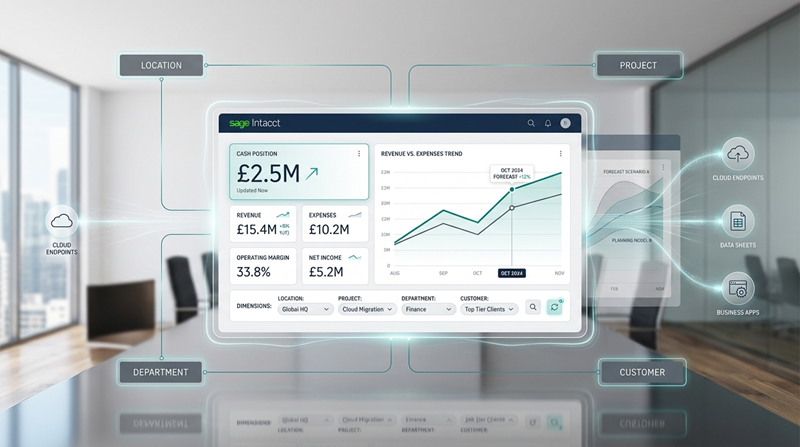
- Real-time visibility in Sage Intacct stems from its dimensional GL and configurable dashboards that merge transaction detail with cross-dimensional analysis.
- Dimensions, such as location, project, department and customer, tag transactions so you can slice data without expanding the chart of accounts.
- Dashboards and scheduled reports refresh with transactional updates and API-fed integrations, so finance leaders always see current cash positions and operational KPIs. That timeliness reduces decision latency and lets financial planning & analysis (FP&A)teams model scenarios quickly, shifting the team from reactive reporting to proactive planning.
Research shows cloud accounting software improves financial management through better accuracy, timeliness and accessibility.
What automation and efficiency advantages does Sage Intacct offer?
Sage Intacct automates repetitive finance tasks, invoice capture, approval routing, recurring entries and close checklists, so teams can reallocate effort toward analysis and controls.
Configurable workflow rules and approval hierarchies reduce exceptions, while audit-ready trails support compliance and external audits. Automated revenue recognition and project billing cut manual adjustments and accelerate invoicing, which improves days sales outstanding (DSO) and makes cash flow more predictable.
These efficiency gains typically show up as faster month-end closes and lower operating costs, allowing finance teams to move from transactional work to a strategic partnership with the business.
How does Sage Intacct support financial transformation across industries?
Sage Intacct adapts to industry needs through configurable dimensions, project accounting, inventory-aware integrations and multi-entity reporting, enabling finance teams to implement workflows aligned with sector drivers. For example, Professional services rely on project accounting and time-to-bill workflows to track utilisation and profitability. These mappings show how platform capabilities resolve real pain points and improve KPIs.
The table below summarises common industry pain points and how Sage Intacct addresses them.
| Industry | Pain point | How Sage Intacct solves it |
|---|---|---|
| Manufacturing | Inaccurate inventory costing and production costs | Integrates with ERPs/MES; dimensional costing gives accurate product margin |
| Professional Services | Delayed project profitability insight | Project accounting with time capture → billing → revenue recognition |
| Distribution | Poor working capital visibility | Inventory valuation and order-to-cash automation for cash optimisation |
These targeted solutions shorten the path to measurable improvements in margin, billing speed and cash conversion, and naturally lead into sector-specific implementation approaches.
Inixion brings practical experience implementing Sage Intacct across manufacturing and professional services and tailors deployments to each sector’s workflows and KPIs.
What are the financial benefits of Sage Intacct for professional services?
In professional services, Sage Intacct’s project accounting tracks time, expenses and revenue with configurable rules that reflect firm billing models. The end-to-end flow,time capture → project accounting → billing → revenue recognition,gives continuous margin visibility and reduces billing disputes. Automated recognition and flexible invoices speed receivables and improve cash flow, while project-level KPIs guide resource allocation and utilisation. Companies can close the loop between utilisation, billing and profitability to focus on higher-margin engagements.
Why choose Inixion for Sage Intacct implementation and support?
Inixion specialises in Sage implementations and support for medium to large organisations. We offer full lifecycle services,from implementation and training to ongoing support and consultancy,backed by a strong track record of project success. Our approach uses industry templates, stakeholder alignment and proven configuration patterns to reduce risk and accelerate time-to-value. We aim to turn platform capability into measurable finance outcomes while building confidence across your finance and IT teams.
| Service | Deliverable | Customer outcome / metric |
|---|---|---|
| Implementation | Industry templates and configuration | Faster go-live; reduced implementation rework |
| Training & Change Management | User training and support materials | Higher adoption rates; lower support tickets post-go-live |
| Ongoing Support & Optimisation | System maintenance and process tuning | Continuous improvement; measured KPI uplift (e.g., faster close) |
These deliverables are designed to convert Sage Intacct capabilities into tangible finance outcomes,shorter close times, improved cash forecasting and clearer project profitability.
What is Inixion’s proven approach to Sage Intacct implementation?
Our methodology follows clear phases,discover, design, build, test, deploy, train and support,using governance checkpoints and industry templates to keep projects on track.
Discovery aligns stakeholders on KPIs and the dimensional model; design defines the chart of accounts and integration patterns that match your organisation. Build and test focus on data migration, workflow automation and user acceptance, while deployment concentrates on cutover planning and communication to minimise disruption. This phased approach reduces risk and sets the foundation for sustained adoption and measurable ROI.
How can businesses maximise ROI with Inixion’s Sage Intacct services?
To maximise ROI, focus on early wins: data clean-up, fast-close templates and a CFO dashboard that surfaces key KPIs immediately after go-live. Prioritise high-impact automations,AP invoice processing, recurring revenue recognition and centralised cash visibility,to deliver quick efficiency gains. Post-go-live optimisation and targeted training lock in best practices, and ongoing support ensures continual improvement tied to tracked KPIs.
Organisations following this approach typically realise faster closes and clearer cash forecasting within the first reporting cycles.
- Data clean-up: Correct master data and tidy balances to improve reporting accuracy from day one.
- Fast-close templates: Standardise close tasks to shorten month-end cycles.
- Dashboard set-up: Deliver CFO-ready metrics immediately to guide decision-making.
These steps build momentum for longer-term transformation and position finance as a strategic partner to the business.
What future trends enhance Sage Intacct’s role in business finance?
Emerging trends,AI/ML for forecasting and anomaly detection, cloud-native scalability and richer APIs for integrations—amplify Sage Intacct’s value by automating insight and enabling extensible finance stacks.
How does Sage Intacct’s cloud architecture support scalable financial management?
Sage Intacct’s SaaS architecture delivers scalable performance, managed security and regular updates without on-premises maintenance, letting organisations add entities and transactional volume smoothly. Its APIs enable integration with ERPs, MES and payroll systems to create an extensible finance ecosystem that supports multi-entity consolidation, role-based security and high availability. This cloud-native foundation reduces infrastructure overhead and frees finance teams to focus on analysis and strategy rather than system upkeep.
Conclusion
Implementing Sage Intacct improves financial management by delivering timely visibility, automating routine work and supporting reliable multi-entity consolidation. Those benefits help finance teams make faster, better-informed decisions and free capacity for strategic priorities. If you’d like to explore how Intacct could work for your organisation, contact our team for tailored implementation and support, discover what your finance function can achieve with Inixion.
FAQs
The Sage Intacct implementation process with Inixion follows a meticulously structured, phased approach. This includes thorough discovery, precise configuration, rigorous testing, and a smooth handover. Inixion leverages industry-specific templates and stringent quality controls to ensure a seamless transition. This methodical approach is designed to minimise disruptions and guarantee that the system is perfectly tailored to meet your business’s specific needs, ultimately leading to a highly successful deployment and the full realisation of the platform’s extensive benefits.
Sage Intacct incorporates robust multi-currency management features that intelligently automate foreign exchange (FX) translation and revaluation. This powerful capability enables businesses to effortlessly manage transactions across multiple currencies, ensuring consistently accurate financial reporting and full compliance with local regulations. By automating these complex processes, Sage Intacct significantly reduces the manual effort typically required for currency conversions and dramatically enhances the accuracy of financial statements, a critical advantage for businesses operating in today’s global markets.
Absolutely, Sage Intacct boasts powerful integration capabilities with a wide array of business systems, including CRM, payroll, and inventory management software. Sage Intacct offers integration to many systems with open APIs for custom connections to tools like Harvest (time tracking), HubSpot (CRM), or your PSA (Professional Services Automation) software.
This seamless integration ensures effortless data flow between systems, drastically reducing manual data entry and significantly boosting overall operational efficiency. By connecting Sage Intacct with your other critical platforms, your business gains a unified, holistic view of its financial and operational data, thereby enhancing decision-making and operational effectiveness across every department.
Sage Intacct is meticulously designed to fully support UK businesses, incorporating essential features that facilitate seamless compliance with local regulations, including robust VAT reporting and comprehensive audit trails. The platform intelligently automates the generation of VAT-ready records, simplifying the preparation of VAT returns and ensuring your business consistently meets its statutory obligations. Furthermore, its powerful audit capabilities provide unparalleled transparency and traceability, which are critical for regulatory scrutiny and maintaining impeccable compliance in all financial reporting.
Sage Intacct proves exceptionally beneficial for businesses within key sectors such as food services, SaaS and software, professional services, and construction. These industries frequently encounter distinct financial challenges, including complex inventory management (for food services), ensuring project profitability (for SaaS/professional services), and streamlining multi-entity consolidation. By delivering precisely tailored solutions like advanced project accounting and real-time analytics, Sage Intacct empowers these businesses to streamline financial processes, significantly improve accuracy, and enhance their decision-making capabilities, ultimately driving superior financial performance.